Read by an AI voice
The other day I was sorting through old photographs on my computer. An ordinary clear-out, the kind you do from time to time.
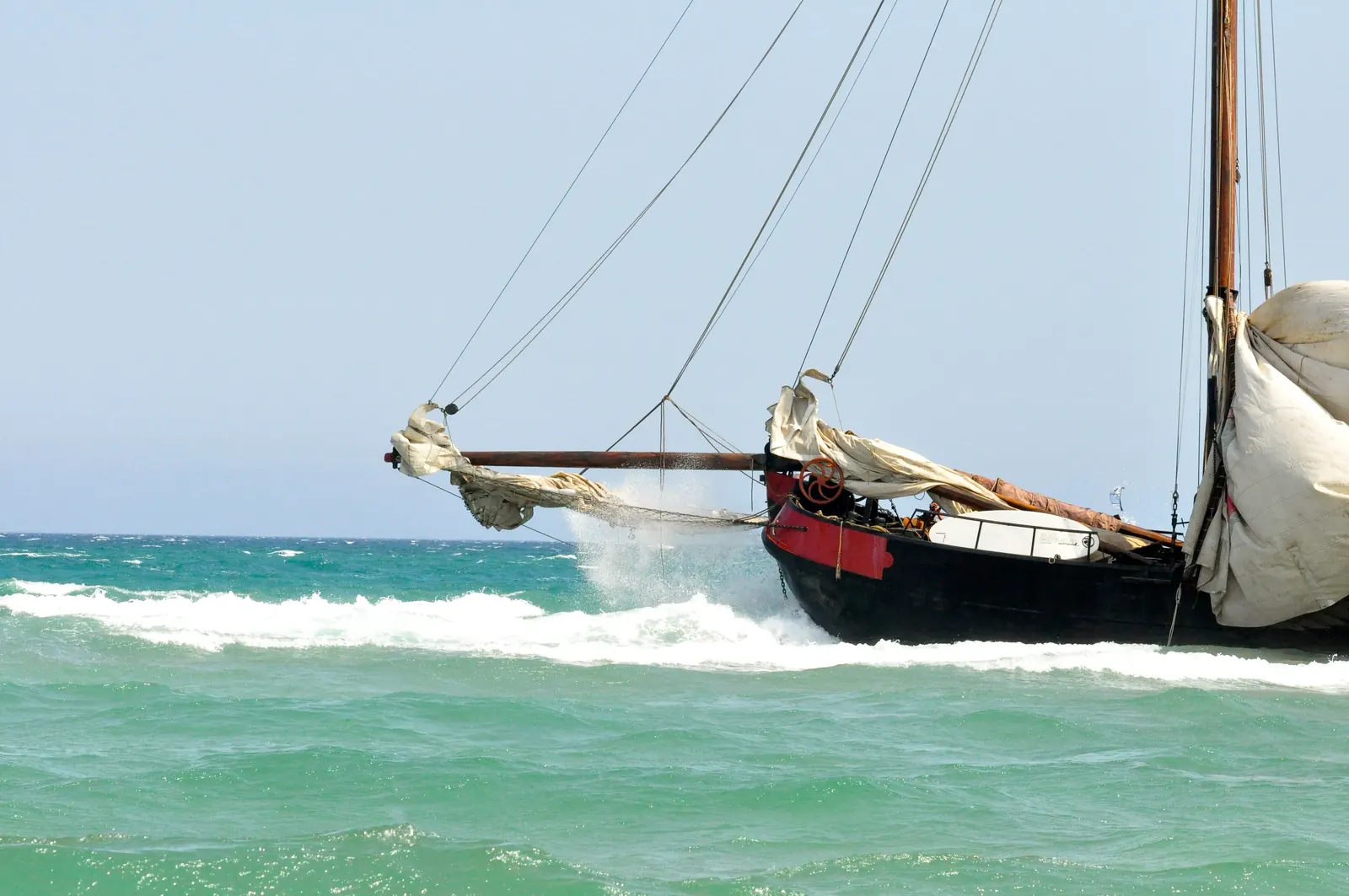
And I came across this one. An old sailing boat, black hull and red strake, run aground at the water's edge. I had photographed it one day without quite knowing why. I don't know the night that came before, nor the name of the boat. I only know what the papers said the next morning: she had run aground because of a problem with her anchor.
A problem with the anchor
Those words stayed with me.
Because an anchor is not just that block of metal you throw overboard. It is an assembly. There is the anchor itself, heavy and solid. And there is the chain that binds it to the boat. Neither is worth anything without the other. A magnificent anchor whose chain gives way holds nothing at all. The boat drifts, and ends up on the sand.
That photograph, found by chance, woke a very simple truth in me.
How often, in the storms — a bereavement, an illness, a doubt that settles in — do we believe at first that we are holding on by our own strength? Our energy, our will, our courage. Until the day those strengths run out too.
The anchor is given
The letter to the Hebrews does not leave us without help:
“We have this as a sure and steadfast anchor of the soul.”
Hebrews 6:19
The anchor is given. It is sure. The text says so plainly. But an anchor holds by its chain.
And that chain is the Scriptures. Every promise is a link binding us to the faithfulness of God.
“Your word is a lamp to my feet.”
Psalm 119:105
Day after day, the simple reading of the Word pays out that chain, link after link. Nothing spectacular. A quiet time, regular, almost humble.
But if that bond is neglected — if prayer and reading break down — the anchor stays on deck. It is there, intact, useless. And at the first gust of wind we find ourselves in danger of ending up aground, the heart weighed down with worries.
It is not in the storm that you check your chain
It is before. In the calm of an ordinary morning, a text opened, a promise read again.
A forgotten photograph reminded me of all this. It still puts the question to me, and I pass it on to you:
And your chain — how is it today?
One thing more
Rereading these lines, an old image came back to me. It crosses centuries and traditions: if all the oceans were turned to ink and the whole sky to parchment, if every man were given a pen — all of that would not be enough to write the love of God. The ink would run dry before the sentence was finished.
You find it among the Jewish poets of the Middle Ages. You find it again, centuries later, in a hymn we still sing.
Could we with ink the ocean fill
and were the skies of parchment made,
were ev'ry stalk on earth a quill
and ev'ry man a scribe by trade,
to write the love of God above
would drain the ocean dry;
nor could the scroll contain the whole,
tho' stretched from sky to sky.
Reserved slot — hymn stanza to be inserted
Frederick M. Lehman, “The Love of God”, 1917 — public domain.
Stanza drawn from the Akdamut of Meir ben Isaac Nehorai (c. 1050).
That is where the image turns around.
My own ink — the ink of pages read again each morning — is the link that holds me. But the ink of every ocean would not be enough to write the One who holds the other end of the chain.
The anchor is greater than the chain. Always.
There is nothing left for me but to hold on to it.