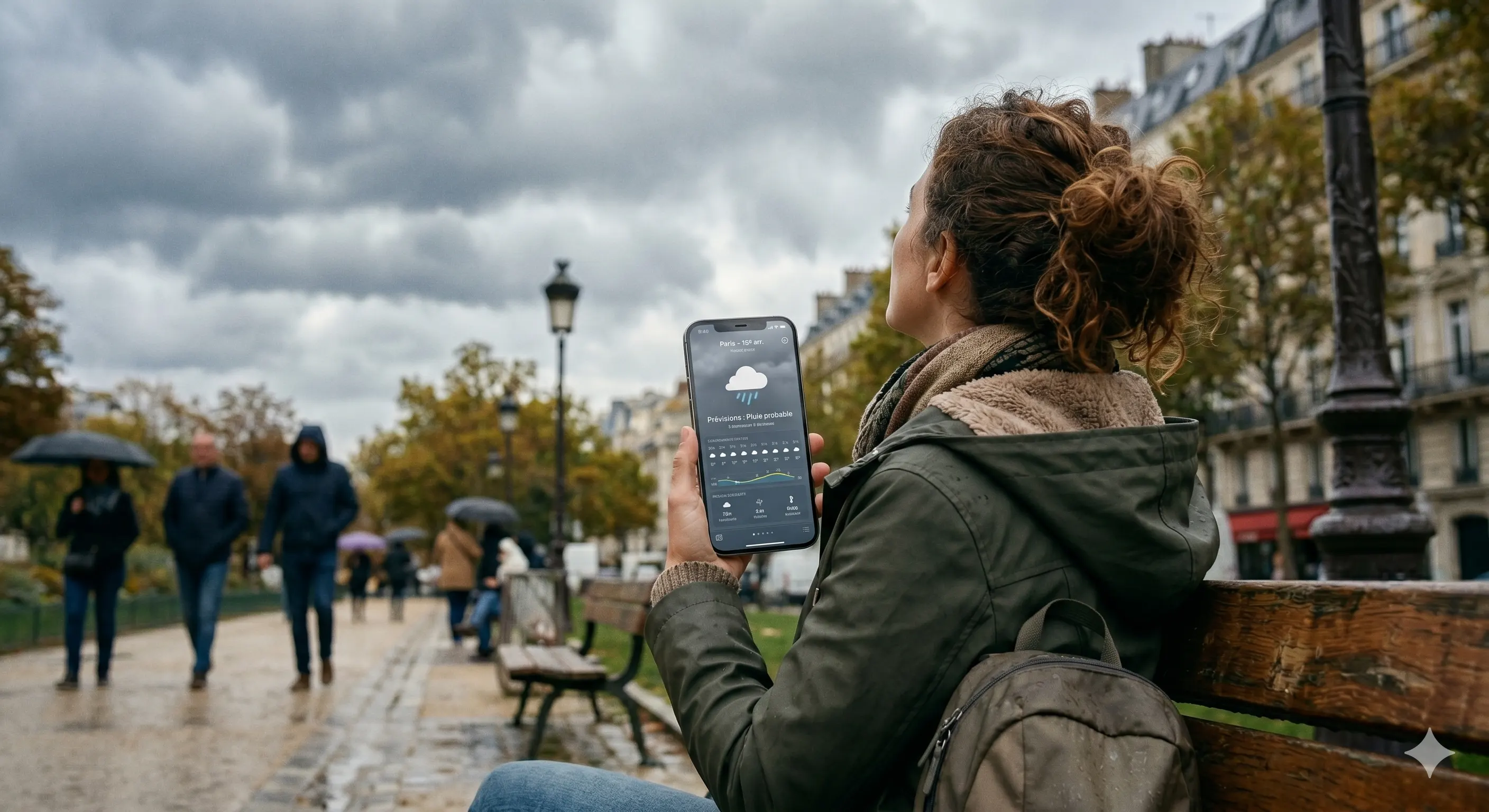
There is something endearing about weather forecasts. We hear about the Azores, the British Isles, Scandinavia, the southern Alps. Names that sound like a geography of childhood.
We don’t get many cyclones here, fortunately. What we do get is that Azores High — watching over our sunshine like a faithful guard dog, steady and reassuring. And then there are the depressions. We understand them so well, these atmospheric low-pressure systems. They spin counter-clockwise — exactly like the other depressions, the ones that fall on us without warning and spin backwards against life to unravel it.
Forecast through tomorrow evening… No need to wait for the evening news any more. Three fingers on the screen, and the whole week unfolds in pictograms: a sun, two clouds, a raindrop, a lightning bolt. We scroll the future the way we used to flip through the pages of the old Post Office calendar. You take the weather as it comes — because however up-to-date the app may be, it doesn’t change the shower.
But that is no reason to hang our whole life on an umbrella.
Many of us live exactly like that: umbrella in hand, eyes fixed on the sky — or on the screen. We learn to protect ourselves. We scan for signals. We anticipate inner low-pressure systems the way others check the weather service. And we end up confusing life with the management of bad weather.
But our life was not made for that. It was not designed to cling to an umbrella. It was made, in any weather, to be anchored high above the clouds.
The apostle Paul writes it with a clarity that unsettles our habits: “Set your minds on things that are above, not on things that are on earth” (Colossians 3:2). This is not escapism. This is not denial of the rain. It is a shift of the anchor point. An umbrella keeps off today’s shower — useful, even necessary. But it cannot hold a life upright. It raises no one. It opens no horizon.
Above the clouds, the sky is always blue. Every pilot knows it. Every soul that has dared to pray in the night knows it too. The atmospheric depression does not tell the truth of the sky; it only tells the truth of the moment. And inner depression does not tell the whole truth about us, or about God, or about what comes next.
Christ offers a different anchorage. “We have this as a sure and steadfast anchor of the soul, a hope that enters into the inner place behind the curtain” (Hebrews 6:19). Behind the curtain — that is, above the clouds. Not below, not beside, not in retreat. Above. Where the light never goes out, even when our personal sky darkens.
This does not remove depressions. It does not make the believer someone who never feels cold. It simply shifts the attachment point. You can be soaked without being lost. You can be passed through by the storm without being swept away by it. “Even though I walk through the valley of the shadow of death, I will fear no evil, for you are with me” (Psalm 23:4). The shepherd does not remove the valley — he walks through it with you.
So today, whatever the weather — the kind in the sky and the kind in your heart — the question may not be “how do I avoid the next shower?” The question is rather: what is my life anchored to?
To an umbrella that holds as best it can? Or to this anchor that enters behind the curtain, and holds no matter what?
“Set your minds on things that are above, not on things that are on earth.”
Colossians 3:2 (ESV)