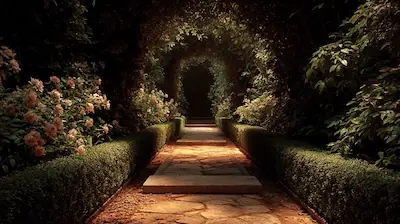
It is sometimes said: if there is disorder in a garden, there is no gardener. And therefore: if there is disorder in the world, there is no God.
It is a simple objection. It sounds solid. But it forgets one essential thing: the world is not a garden.
In a garden, the gardener decides everything. He uproots, plants, prunes. The soil obeys, the weeds bend, the flowers are beautiful and silent. It is a place of obedience — and beautiful, in its way. But it is not a place of freedom.
The world, on the other hand, is the place of freedom. And freedom causes damage. The free man can grow crooked, wage war, starve his neighbour, crucify Christ. He has done all of this. He still does.
So why did God choose this? Why take the immense risk of a world handed to free beings, rather than a perfectly ordered garden? Because a garden cannot love. A flower planted by force does not freely give its fragrance. And God — if we believe him as the Bible reveals — did not want automatons. He wanted children. Creatures capable of saying yes or no, of choosing or refusing, of loving or turning away.
“I have set before you life and death, blessing and curse. Therefore choose life, that you and your offspring may live.”
Deuteronomy 30:19 (ESV)
The disorder of the world is not proof of God’s absence. It is the trace of the freedom he entrusted to us — with all it permits that is terrible, and all it permits that is great.
So the question remains whole, and it looks back at us: with this freedom — you, me — what do we do with it?